Behind Benzansen

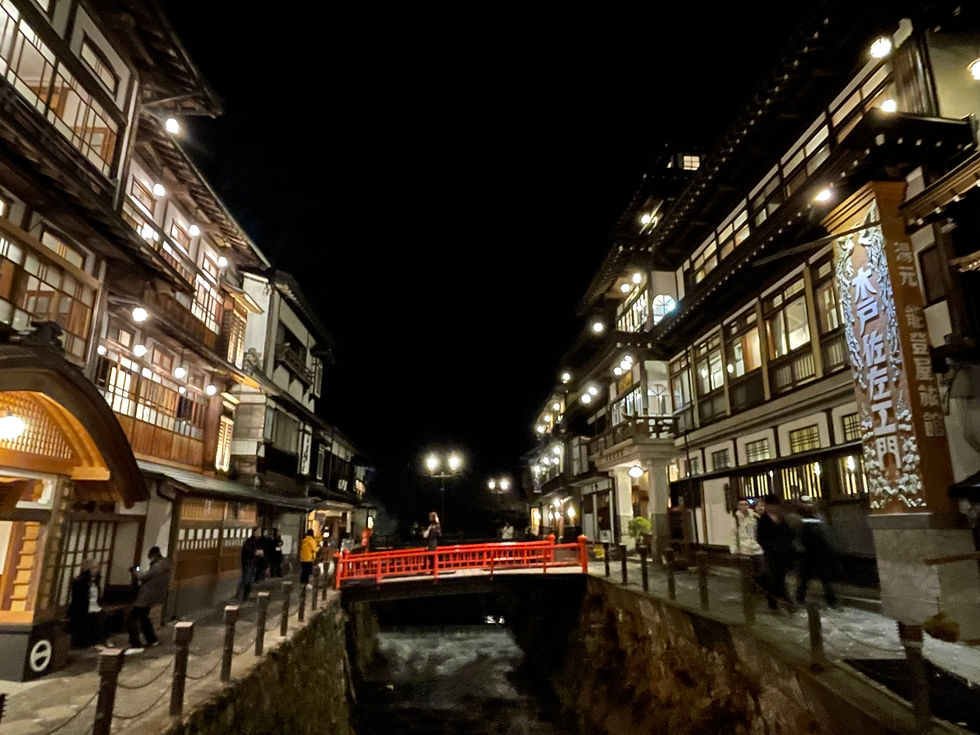
The steam rising from the thermal canals cutting through the streets looked rather eerie in the darkening light, and the smell of sulfur was strong in the air. At this point, it felt like we'd crossed over hundreds of arched, red bridges, walked past an uncountable number of tall, black lamps glowing with colorful essences, passed an insensible number of buildings made out of what seemed to be delicate, artisanal paper — endless small, white rooms with deep brown wooden accents, illuminated with endless yellow lights glowing out of their double windows, and black roofs peeking out every couple stories or so.
Every once in a while, a tall, wooden pillar in front of a building or large, gold-tinted tree stump, marked with Akenian characters, labeled the locations.
Although I could read them, I had no idea where we were.

Benzansen, Akenia, the primary setting of The Eyes of Cordiayari and the location of A.M.P.A., is primarily a combination of two of my favorite towns in Japan: Beppu (別府市) and Ginzan Onsen (銀山温泉) (with a taste of Venice thrown in for flavor, but more on that in my post about the inspiration behind A.M.P.A.). The name is — perhaps unsubtly — a combination of Beppu and Ginzan Onsen.
I was rather taken with Japanese onsen (hot springs) and frankly couldn't get enough of them during the time I spent in Japan. Unsurprisingly, this love of hot springs is why I just had to include an (unfortunately heavy) hot spring scene in The Eyes of Cordiayari, but I will talk more about onsen in general in a separate post.
Back to Benzansen, specifically. For three weeks in November and December 2023, my mom came to Japan to visit me and we took one final "last hurrah" trip around Japan before I moved back to the United States. We tried to hit all of the spots that I had really wanted to visit but hadn't had the chance to get to yet — in part because these places were comparatively far away or difficult to reach from Tokyo with my limited time off as I worked full time.
The island of Kyushu — the third largest island in Japan — is known for its onsen, especially the city of Beppu. It is a charming place, and I was quite taken with it, even despite some quirks that I didn't expect and about which my mom and I will endlessly laugh. Parts of the city feel a little bit less "composed" and "upright" than the parts of Japan that you expect and that you see on social media. The first Beppu onsen that we visited when we arrived was Takegawara Onsen (竹瓦温泉). When you read travel guides about Beppu, most of them will say you must visit this place. It is one of Beppu's oldest hot springs, and the exterior is indeed beautiful!

And now, the funny bits. Takegawara is surrounded by pieces of Beppu's red light district. (You can perhaps imagine how strange it feels walking through a red light district not once, but twice, with one's mother!) On top of that, the "bath" part of the onsen was just one single bath pit in a white tile room. As someone who had gone to a lot of the fancier (and more modern) bath houses, to see only one, small, shared bath, in which people seemed to be actually bathing was a bit of a shock! At the same time, though, it is important to appreciate that public bath culture has certainly evolved in Japan — and everything does have to start somewhere. And Beppu has some of the most wonderful bath houses, some that feel quite traditional and others of which are beautiful, modern constructions with sweeping views of the city.
Unfortunately, that quirky little bath house didn't make it in as a direct inspiration for Banzansen, but what did was the general city landscape. One of my favorite things about the city was that when you look out on it from a high point, you can see plumes of steam rising up from the various bath houses, a reminder that there is an insane amount of natural volcanic activity happening all around the landscape and around which the city has been built. To me, the fact that there are just plumes and plumes of steam rising up from the ground like that feels positively enchanting and otherworldly, so I couldn't resist incorporating it into the other world that I built myself.
Before us, the expanse of the city was just beginning to light up, bathed in the warm, yellow lights that just seemed to invite the viewers to step inside and adopt these places as their homes. Above the lights were rising plumes of steam from all directions, making their way lazily into the sky before at some point becoming one with the color above.

You can also see these beautiful plumes of steam rising from storm drains, bath houses, and the streets themselves as you walk through the city. Especially at night, the magic of such a place is clear. While some may find it off-putting, I adored the smell of sulfur produced by all of this volcanic activity. When you've been to enough hot springs, you start to associate the smell with relaxation (at least, I do).

Moving on to Ginzan Onsen. Ginzan Onsen is an old silver mining town located in Japan's Yamagata prefecture. It is one of the locations that claims to have been the inspiration between the Studio Ghibli film Spirited Away. I say "one of the locations" because there are a few different locales around Japan (and one in Taiwan, from what I've heard) that claim to have been the inspiration for Hayao Miyazaki when he designed Yubaba's bath house.
Spirited Away inspiration or not, Ginzan certainly makes you feel like you're in some kind of fantasy setting. The thermal river flowing through the center of the little town — above which rose copious steam against the cold mountain air — served as an inspiration for the thermal canals that run through the streets of Benzansen (with a nod to the Venetian canals as well — I just can't get enough of canal cities). The buildings lining Benzansen's streets are also directly inspired by the beautiful bath houses and shops on either side of the canal in this charming mountain locale.
If you're fortunate enough to be there when it snows, it is perhaps one of the most magical, cozy scenes that exist in this world (but maybe I'm biased). Rather convenient that we were able to get in a freak summer snow in Benzansen, don't you think?
I walked through the streets of Benzansen, still quiet, as people were just beginning to rise, and everyone was moving slowly with the snow. The faint lights of the homes around me sparkled against the snow, and the thermal canals running through town painted a stark, snowless contrast to all of the snow around them as the steam rose dramatically into the air in all directions. The contrast of the red bridges with the white snow was especially striking.
If I could knock anything about Ginzan Onsen, it's just that it is very small. It is so beautiful, but when you're exploring it and taking pictures, you find yourself desperately wishing there was more of it — something that, once again, isn't really captured by the travel ads and social media posts. I took the liberty of expanding it when creating Benzansen, creating multiple canals, bridges, and winding streets to make sure that no Benzansen visitor is left wishing that the city was bigger — in fact, Celia's words make it sound like she wishes the city were smaller.
Despite the heaviness of the events that occur in Benzansen, I also wanted the city to capture the wonder that I felt in various parts of Japan, especially Beppu and Ginzan. To me, the most wondrous travel experiences are always the ones where I feel like I have been transported so far away from something that feels like "home" to me that I feel like I have stepped through a portal to another world. I believe that it is perhaps when we feel the most out of our element that we really begin to feel the magic of somewhere else. I've come to learn that everyone has those experiences in different places. Some people are just "taken" with certain parts of the world — there is something about those places that just make our hearts sing in a way that others don't. I hope that the streets of Benzansen transport you there, if only for a moment, and capture the way that I felt exploring Beppu and Ginzan, feeling my imagination take flight with the wonder of these stunning Japanese masterpieces.
With Wonder,
Gianna
