About A.M.P.A.

Looking back, knowing what I know about A.M.P.A., it does make sense that of all the schools, Celia would be at that one — the posh, prestigious essences university located in Benzansen, Akenia, the wealthy capital of one of the wealthiest countries in AT.
A.M.P.A. — an Akenian acronym for the Alcazar Academy for the Education of the Empowered — is the setting of the main events in The Eyes of Cordiayari. Celia has attended A.M.P.A. for many years, including the sister school for younger children before she reached university age, while Terrence comes to A.M.P.A. for the first time in pursuit of Celia.
There is so much about A.M.P.A. — in appearance, politics, and culture — that were (perhaps unsurprisingly) inspired by my time at the University of Cambridge — specifically, Trinity College. For those who aren't aware, the University of Cambridge (and Oxford, "the other place"), is divided into "colleges", which are primarily responsible for overseeing their students' studies, accommodation (if the college provides accommodation for all of the student's time at university), and general wellbeing. Before I attended Cambridge myself, I had no idea that there is a very pronounced system of hierarchy between the colleges. It's a known mark of a tourist to wear a "University of Cambridge" sweatshirt. Real Cambridge students don't rep Cambridge — real Cambridge students rep their college, and the prestigious colleges will remind you continuously of their prestige.
Why talk about this? It's important to note that when I discuss the politics of Cambridge, although I didn't choose to divide A.M.P.A. into colleges, I am thinking a lot about Trinity College, specifically, and not just the University of Cambridge as a whole (although Cambridge as a whole, of course, also heavily influenced my representation of A.M.P.A.).
And yet, the outer facade of A.M.P.A. isn't influenced by Cambridge at all — it carries influences of Venice (surprise!) and varied Japanese architecture (perhaps less surprisingly). So, let's start there.
The Exterior of A.M.P.A.
The massive square base of the perimeter of the university is encircled by gargantuan white columns which tower above even the tallest person and open into archways, which, from the outside, the viewer mysteriously can’t see past. It’s as though the structure isn’t even there.
The exterior of A.M.P.A. is inspired by the Doge's Palace in Venice. I visited Venice back in 2018 (before I lived in either Japan or the U.K.). Compared to the rest of my travels, it was such a long time ago that I actually don't have a picture of it on my phone! (You would think I could scrounge up at least one, given that I have nearly 100,000 photos.) For the longest time, if you asked me what my favorite place in the world is, I would say Venice. Maybe it's the lack of cars, the presence of water everywhere you look (which is always something that I, personally, crave), or the history of every single street, but there is just something special about it. Plus, it's perhaps the most famous canal city (I've heard Amsterdam described as the "Venice of the North" and different places in Japan described as the "Venice of Japan"), so it's only fitting that there is some tribute to this canal city in Benzansen — also a canal city.

Of course, I couldn't only imitate the Doge's Palace in creating it. The upper half of its exterior clearly carries Japanese influence. Read on to learn about the Japanese origins of this design choice, merged with some flavors of Cambridge.
A.M.P.A.'s Roof and the Looming Presence of the Alcazar Family
The presence of the Alcazar family is so blatantly clear in the design of A.M.P.A. that Celia cannot describe the university without also describing them.
The second I’d arrived, I’d felt judgement from the students gossiping from the delicate white balconies and tables above those archways, all while the symbol of the prestigious Alcazar family — the founders of the university and its sister school — hung above their heads over and over again: at the top of each archway; carved above the small windows within the deep turquoise, reflective stone expanses above that; and at the end of the perfectly circular, gradually slanting, glimmering white stone cylinders that line the roof, peppered with the turquoise stone to accent the symbol’s presence and coming to a dramatic point at the top, decorated with a lavish green vine centerpiece that spills over the whole roof.
I cannot point to any one single structure that inspired this design exactly (there are a lot of temples in Japan [and other parts of Asia, for that matter — Japanese Buddhist architecture finds its origins in China, after all] that demonstrate these types of design elements), but I will say that I was perhaps most struck by designs such as this while I was in Fukuoka, on the island of Kyushu. Fukuoka's Hakata Old Town has a "temple walk" which I did on my first day there. It took me to so many temples that I lost count of them all. Perhaps it was just the sheer number of temples that I saw in a single day that made me really appreciate this architecture even more than I had before.
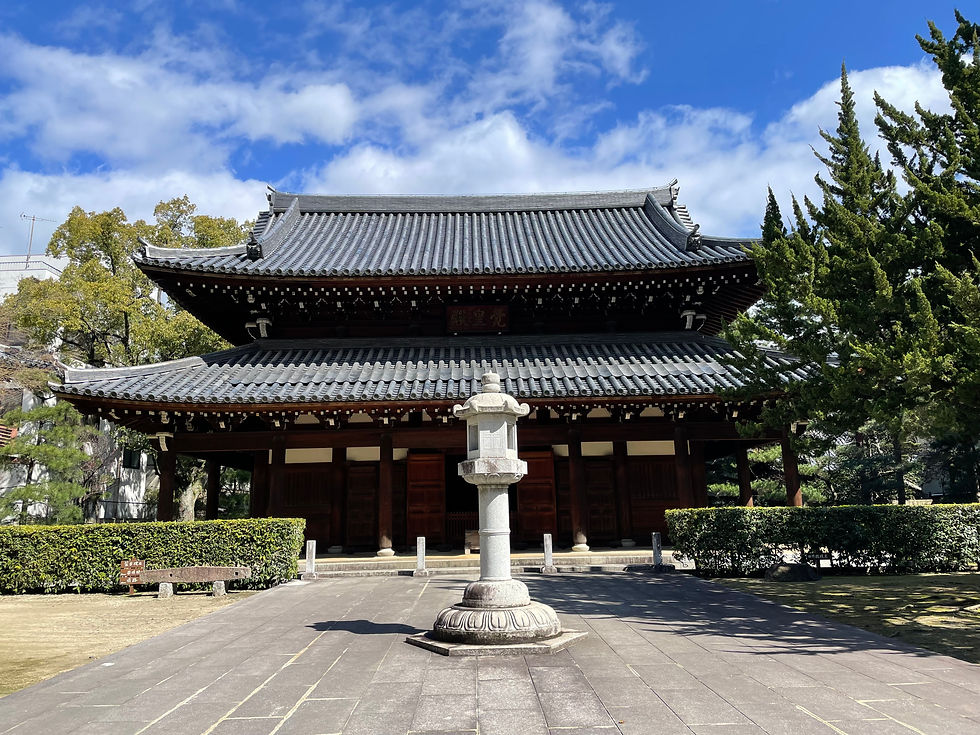


You can see in each of these structures the "gradually slanting ... stone cylinders" lining the roof and the rooftops coming to a "dramatic point". Having never been to Asia before Japan, I particularly enjoyed the pointed roofs, hence their inclusion in the design of A.M.P.A. I did, as you can clearly see from the description, take some liberties with the colors that I used when I designed A.M.P.A.
But how does the Alcazar family relate to all of this? Well, you can see one element repeated continuously throughout the design of A.M.P.A.'s roof. Celia remarks on it herself.
Yes, that Alcazar family symbol – the looping vine, covered evenly with pairs of leaves throughout its expanse, forming a hollow loop in the center, and cascading downwards – is plastered all over the school, reminding students constantly that their existing here is dependent upon the historic generosity of that family.
That was another thing the struck me about each temple: the uniformly decorated, rounded ends of the roof tiles, known as gatou (瓦当). (You can learn more about those here.) There were so many different ones on display on my temple walk in Fukuoka. From my understanding, these can have a variety of meanings, including being Buddhist symbols or family crests. The idea of a family placing their crest on the end of each roof tile was particularly interesting to me, so I integrated this into the roof design of A.M.P.A. The specific crest design I selected was also inspired by a temple that I visited in Fukuoka.

Interestingly, while the continuous placement of a family crest on the roof of a building in this way is undeniably inspired by Japanese temples, the spirit behind this choice very much reminded me of my time at Trinity College — which carries some (not so subtle) reminders of Henry VIII's claim as founder of the college. Perhaps you'll see better what I mean by this as I delve into a description of the Trinity College dining hall which, naturally, inspired the A.M.P.A. dining hall.
The Dining Hall: A Trinity College Establishment
The dining hall is a long building, consisting of long wooden tables that run the entire expanse of it. Unfortunately, this means that it’s hard to entirely avoid sitting next to or across from someone, unless the hall is empty which — of course — it wasn’t.
...
I tried to focus my gaze on the long expanse of white marble statues on either side of the seemingly endless hall, above whom float a constant swirl of colored smoke.
Recently, I overheard a student say that the colored smoke is said to be the manifestation of a small amount of the essences of each figure when they were alive.
When the marble figures refused to help me fight the intensifying stares of the people around me, I tried to stare at the chandeliers above, intricate and delicate gilded fixtures from which glow gold and purple swirls of essences in the place of candles and above which is a high, pointed ceiling, on which is painted a detailed scene.
In the end, my eyes focused on the massive statue of Edward Alcazar — which stands significantly taller than all of the other statues and above which swirls what seems to be a miniature storm of turquoise smoke — as I paraded my way down the long expanse of tables towards the back where there appeared to be fewer students.
"Hall" is a key part of the culture of Trinity College, and I wanted to capture that here. The long tables that run across the expanse of hall mean that indeed, in busy hours, you may have to search for your friends — or else you might end up sitting across from strangers. When I was in college, the introvert in me tried to always coordinate hall attendance with friends to make sure that I didn't find myself in the very same situation as Celia here — searching desperately for someone that she knows that she can sit with.

But beyond the culture, the design of A.M.P.A.'s hall mirrors that of Trinity's, too. The walls of Hall are lined with portraits of past college masters. During my time, they added another one for the newest master, Dame Sally Davies, who became master the same year that I matriculated.
The length of Trinity's hall culminates in a massive portrait of none other than Henry VIII, England's infamous king and the accredited founder of Trinity College. (I say "accredited" here because common Cambridge lore says that Katherine Parr, the last of his wives, asked him to found Trinity College, although a somewhat recent re-examination of Trinity's history by Professor Richard Rex claims that Henry had already decided to found the college without the intervention of Katherine Parr).
Regardless of which version of events you believe, Henry VIII largely gets the credit — and the massive portrait. I kept this idea when designing A.M.P.A.'s hall, but replaced the portraits of the masters and Henry VIII with statues of Alcazar and other important figures in the school's history.

But perhaps now you can see how I felt that a family crest being engraved into every roof tile of a building just made sense to me in the Cambridge-inspired sense, even though it is also sometimes a Japanese practice. Who else besides a Cambridge, Oxford, or A.M.P.A. student can say that a massive representation of a long-dead historical figure loomed over them while they were eating all of their meals?

Before I move on to a few notes about the politics and culture of A.M.P.A. and how they mirror those of Trinity, College, a small note for anyone interested: even the layout — the serving area being across from the dining hall itself — mirrors the layout of the Trinity College Hall.
The second I stepped into the dining hall after getting my food from the kitchen across the way, I tried to pretend like I didn’t notice all of the staring incessantly beating down on me.
The Politics and Culture of A.M.P.A.: Trinity and Cambridge Abounding
There are so many different experiences that I had at Trinity College (and Cambridge more broadly) that shape the world I've built and how my characters experience it. I cannot even begin to cover all of them here (and The Eyes of Cordiayari is by far not the only work I intend to create that will delve into them), but in this post, I will outline a few selected cultural and political components of A.M.P.A. that I feel are some of the most obvious indicators of the way that my depiction of the school is influenced by my experiences at Trinity. The rest of them will have to be left up to interpretation — at least for now.
“Where are we going?” I asked. She was still holding my hand, playfully leading me along.
“The board of directors is meeting to discuss what to do about Celia’s actions. I want you to see it.”
...
It struck me that, especially as a new student, it was odd that she was able to find this. “If audiences aren’t supposed to watch, how do you know about it?”
“My dad’s good friend is on the board of directors. Don’t you worry. He knows we’re here. He owes my dad more than one favor.”
“This is one of the personal observation rooms for the board of directors. Look there.” I approached the window. Through it, I could see a circular table ringed by chairs. Our eyes, looking through the windows, were about at seat level with the chairs.
At Trinity College, the College Council was responsible for a great number of decisions, as was "the University" — as a student, I was never quite certain who exactly made up either of these bodies in their entirety. I do know that the College Council has a meeting room that students are not usually privy to. In my time at Cambridge, I never saw this room or knew where it was, although one of my friends has since been inside (after graduating).
To my knowledge, there was no way to secretly observe the deliberations of the College Council — but it is fun to consider the possibility. Rather, the nebulousness of the College Council is easy to speculate about for any student that thinks about it, captured well by Terrence's tutor telling him that if he wants to speak to the board president:
“...she usually hosts a tea in her lodge once a year for all of the students to meet her — all of the student body is invited on rotation. So, you’ll meet her eventually in the next few years. She’s a lovely woman.”
This was real. I did, indeed, get to attend one session in the Trinity College Master's Lodge where I got to meet College Master Dame Sally Davies. (I was also instructed when I joined Cambridge that I could address her as "Dame Sally" or "Dame Sally Davies" but never "Dame Davies".)

Another, perhaps more comedic version of this "secret" council could be seen if a Cambridge student got "deaned" (although I do believe that this group was composed of different individuals than the College Council). If you got in trouble (or if you were doing especially poorly academically), you would be called in to see the Dean of the college. You were required to wear your gown (our academic robes that we wore for formal dinners and graduation) and were summoned to sit at the far end of a long table, flanked on either side by the college tutors (basically, the college professors responsible for students' well-being) and headed on the other side by the dean. It all seems rather dramatic and formal. I must say that one of my greatest regrets of Cambridge was that I never got deaned — what a story that would have been!
While neither Celia nor Terrence is ever deaned, the tutorial system comes up briefly when Terrence is trying to investigate Celia's well-being; I did, of course, directly copy this system from Cambridge. But beyond that, I feel that this quote represents something else that is uniquely Cambridge in culture.
It continues to be a nonissue for the school that she [Celia] is entirely shirking her classes. Today, uncertain where to go, I visited my tutor and asked him if he had any information about Celia.
Perhaps I was too straightforward, for the answer I received was, “Well, I have some, I suppose, but I can’t just disclose it to you, I’m sorry. That would be a privacy violation.” He paused. “Is there reason to believe that I should be concerned about your relationship with Celia Noland?”
I wasn’t sure what he was getting at there, but I answered, “No, it’s just she … hasn’t been in classes lately, and I wanted to know if she was okay.”
“Well, do you know her?”
“Yes.”
“And you’ve spoken to her?”
“In a sense.”
“Then it sounds like she’s fine.”
“But doesn’t she have a duty to attend class?”
“My, aren’t you the studious one,” he laughed, patting me on the back. “When it comes to Celia Noland … you can think of her as a special student. She’s not here to study like a regular student. She’s almost like … a scholar. Yeah, she’s like a scholar, welcome to come and go to classes as she pleases. … It’s better for everyone that way.”
“I see.”
He nodded, satisfied with himself.
The relatively "hands off" approach to student welfare was my general experience at Trinity College and Cambridge more broadly. I wasn't graded for participation or showing up; only exam grades at the end of the year mattered (and, arguably, only the exam grades at the end of my final year really mattered.) It was largely up to me to be responsible for my studies and my choices. This was not to say that nobody was supervising me: my Director of Studies was quite involved (I was fortunate to have a very helpful and supportive one) and my Tutor was willing to help me a lot (beyond my required three minutes per term that I was required to meet with him — yes, that was a thing). Nevertheless, the overall atmosphere of Cambridge was incredibly independent. The description I've heard of the education system is "You're dropped in the deep end and expected to learn to swim", and that is accurate. I learned so much about being confident learning on my own and speaking out about my knowledge, but it was a rather rapid transition into what felt like total independence.
I know the amount that you're supervised varies in other universities around the world, but I do think that a Cambridge-like setting lends itself particularly well to the events of our story. Celia is able to fly relatively under the radar which, in this case, is quite unfortunate.
Although, speaking of student welfare, before concluding, I would be remiss if I didn't mention one of the most wonderful institutions of Trinity College — the college chapel.
The chapel existed as a faith-neutral student-welfare institution that hosted activities for students. The chaplains were genuinely some of the kindest, warmest people I've ever had the pleasure of knowing, and I made so many wonderful memories attending the activities that they organized. I didn't get to include the chapel much in The Eyes of Cordiayari, but they did get a brief shoutout for hosting a memorial service.

Final Thoughts
A.M.P.A. is supposed to feel like a contrast — at least architecturally — to the rest of Benzansen. Despite the Japanese influences I couldn't resist adding, the school is overwhelmingly Italian in its exterior design and British in its interior and culture. It's supposed to be. We must not forget that the school was founded by non-Akenians, after all.
In my next post, I will explore the inspiration behind this contrast. For now, thank you for reading.
With Wonder,
Gianna
